The Tribe Trap and the Muzzle of the Native
DOI:
https://doi.org/10.65439/q7da6362Keywords:
Pan-Africanism, epistemic sovereignty, tribe, pseudospeciation, In-Group Psychopathy, political linguistics, Kongo statecraft, federation, ATSS 1.0Abstract
Context. For more than a century, Africa has been ruled and narrated through a single downgraded category: the “tribe.” Conflicts in Sudan, Ethiopia, DRC, Nigeria or the Sahel are routinely described as “tribal violence,” implying ancient, irrational feuds. Equivalent conflicts in Europe or Asia are framed as “nationalist,” “federal,” or “geopolitical.” The same empirical complexity is run through different conceptual filters.
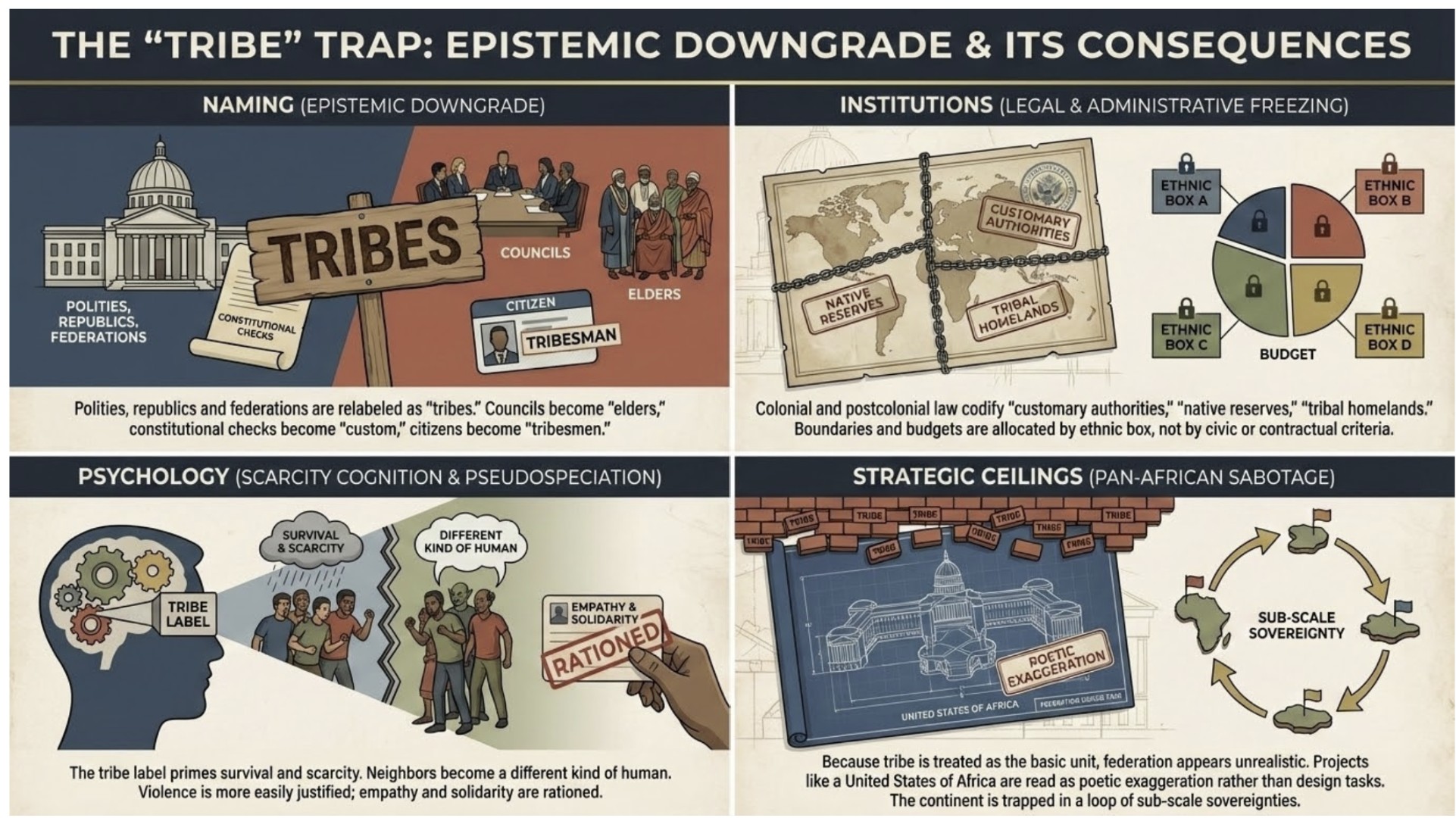
Problem. We argue that tribe is not a neutral translation of African social units but a muzzle: a technology of epistemic containment that reclassifies sovereign polities as biological specimens. It collapses layered governance (lineage, city-state, alliance, federation) into biology, erases indigenous concepts of state and contract, and triggers In-Group Psychopathy through pseudospeciation (seeing neighbors as another species) (Erikson, 1966; Bandura, 1999).
Research question (Singini). Does the imposition and internalization of the tribe label (a) systematically erase indigenous concepts of sovereignty in African political vocabularies and (b) measurably increase zero-sum, dehumanizing framing in conflict discourse, thereby lowering readiness for alliances and federations?
Method (protocol, Ma1–Ma2). We specify a mixed-method design:
(1) A comparative linguistic audit of political vocabulary in five major African zones (Kikongo, Yoruba, Igbo, Amharic, Wolof) versus colonial translations, coded through a “Disconnect/Muzzle Matrix” (Johnson, 1921; Van Wing, 1921; Vansina, 1990).
(2) A framing experiment comparing “tribal conflict” wording to precise mechanism wording (institutions, incentives, jurisdiction) and measuring effects on blame attribution, solution preference, and federation support.
(3) A diagnostic tool, the In-Group Psychopathy Diagnostic Protocol (IGP-D), to score media and policy narratives for pseudospeciation and moral disengagement (Bandura, 1999; Erikson, 1966).
This is a conceptual + protocol paper: it specifies mechanisms and preregisterable tests and reports pattern-level archival observations, but does not analyse any newly collected empirical dataset.
Results (current status, Kia). Desk-based audit of existing dictionaries and histories shows a consistent pattern: indigenous terms for city-state, republic, confederation, nation and citizen (Nkangu, Ntotela, Ilú, Ọ̀yọ́ Mèsì, Obodo, Hager, Réew, Isizwe) are routinely translated as “tribe,” “village group,” “paramount chief” or “customary elders” (Van Wing, 1921; Johnson, 1921; Southall, 1970; Vail, 1989). This is a structural erasure of sovereignty concepts, not a random vocabulary gap. We treat these as pattern-level findings, not a fully executed quantitative study, and specify precisely what data would falsify or weaken the model.
Conclusion (Wa–Nga). Pan-Africanism cannot be engineered as a “unity of tribes.” The tribe is a non-scalable unit for sovereignty. Once the correct layers are restored, lineage (luvila), people/ethnos (kanda), country/jurisdiction (nsi), alliance (nkangu), confederation/state (ntotela), continental integration becomes an engineering problem: federating jurisdictions through enforceable alliances, while protecting identity as culture. We outline an implementation package: a No-Tribe precision style guide, an AU “No Tribe” policy directive, and a monitoring protocol that treats tribe framing as a measurable security risk