Archives
-
Scripts of Power: Writing, Epistemic Warfare and Political Order
Vol. 26 No 1 (2022)This issue of the USK Journal of Political Science and Epistemology opens with a simple, unsettling question: who writes the world we live in? From Papal Bulls that sanctified conquest to the colonial grammars that dissected African languages, political domination has always been a question of script and speech long before it became a question of armies and banks.
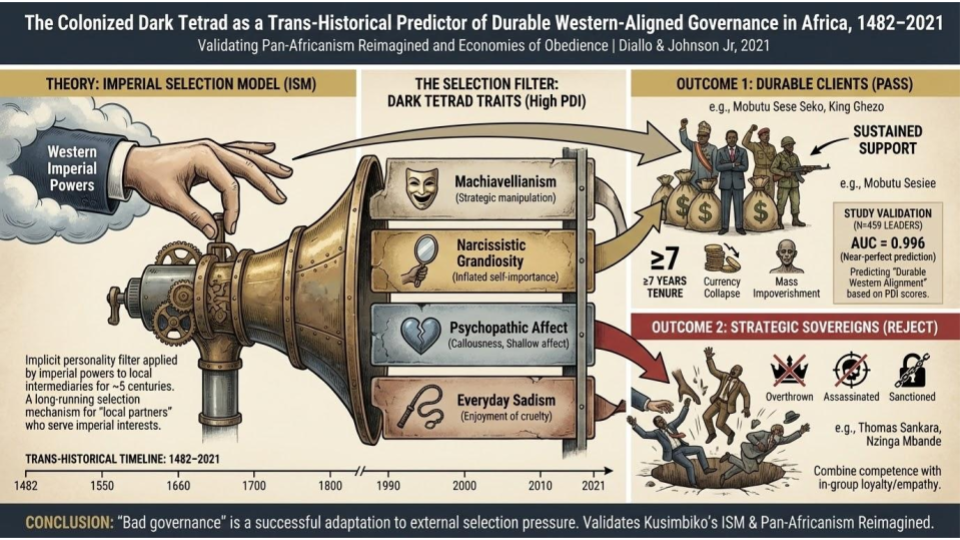
Bringing together political science, linguistics, theology and decolonial epistemology, the issue argues that the African crisis is not only institutional or economic but symbolic. In the lead article, Kibavuidi Nsiangani revisits his programmatic work Pan-Africanism Reimagined (2010) to show how sentimental calls to unity have replaced the hard engineering of federative institutions. He links this failure to deeper patterns of manipulation described in his later clinical analysis of imperial behaviour (The Dark Tetrad Traits of Empire, 2014) and to the long history of “scriptural sovereignty” built by Europe over Africa.
The other contributions explore different faces of this symbolic struggle: Mandombe as an epistemology of power rather than a folkloric curiosity; language through the example of Kikongo as a dense, prototype-like language whose internal logic was fragmented by colonial lexicography; the genealogy of theological and legal texts from Papal decrees to policy briefs that normalised dispossession; and the university as a contemporary battlefield where curricula, languages and citation regimes either prolong or contest this order. Together, these articles sketch the outlines of a research programme in which political institutions, linguistic structures and writing systems are analysed as one and the same field of combat.
Rather than closing the debate, the issue deliberately leaves open questions for future work: how to model political prediction using African symbolic systems, how to design federative mechanisms that are faithful to indigenous grammars of relation, and how to build clinical tools capable of diagnosing the structural pathologies of empire. What is clear already is that no durable sovereignty is possible without a revolution in how Africa writes, speaks and teaches itself.
-
Intimate Tyrannies: Family, Religion and Micro-Structures of Power
Vol. 27 No 1 (2023)This 2023 issue of the USK Journal of Political Science & Epistemology shifts the analytic lens from empires and institutions to the microscopic theatres of power: families, churches, universities and courts. Building on the 2022 issue Scripts of Warfare, which demonstrated how writing systems, languages and canonical texts shape global hierarchies, this issue asks a disturbing but necessary question: how do those same logics inhabit our most intimate relationships?
The opening article extends earlier research on imperial psychology (The Dark Tetrad Traits of Empire, 2014) and colonial governance (From Mvemba Nzinga to Modern Puppets, 2016) to show how the micro-politics of narcissistic families prefigure authoritarian states. Subsequent contributions examine churches as laboratories of obedience, mothers-in-law and bridewealth as mechanisms of political economy, universities and seminaries as training grounds for the colonised mind, and constitutional law as a potential site for anti-narcissistic safeguards.
Throughout, the authors dialogue with Scripts of Warfare: they treat Pan-African federation not only as a geopolitical project but as a transformation of affective and cognitive patterns in households; they revisit Mandombe and Kikongo not merely as symbols of sovereignty but as tools for naming and resisting everyday domination. The issue closes by sketching a research programme on anti-narcissistic constitutionalism, where legal, educational and spiritual reforms converge.
The central wager of this issue is that no political liberation is sustainable if the micro-structures of power remain organised according to the same narcissistic grammar that underpins empire.