The Cognitive Impact of Learning Mandombe in Adolescence: A Longitudinal Study
Keywords:
adolescent cognition, education, decolonization, neurodevelopmentAbstract
Title
Neurocognitive Evolution in Adolescents Following 18 Months of Mandombe Instruction: A Controlled Cohort Study
---
Abstract
This study examines whether 18 months of systematic Mandombe instruction is associated with specific neurocognitive changes in adolescents beyond those expected from age and standard schooling alone. Rather than importing foreign test batteries, we first derived visuospatial and moral tasks from existing MEN-D classroom activities, piloted them locally, and then constructed formally equivalent neutral versions for non-Mandombe peers. Both cohorts therefore worked with tasks that were structurally comparable in difficulty and format, but culturally intelligible.
Two matched groups of 12–16-year-olds in Kinshasa were followed over an 18-month interval. The Mandombe group (MG) received regular Mandombe instruction (≥3 hours/week) in addition to standard schooling. The control group (CG) followed standard programmes without exposure to Mandombe. At baseline (T0) and after 18 months (T1), we assessed mental rotation, visuospatial and verbal working memory, non-verbal reasoning, and moral reasoning on Congolese school- and neighbourhood-based vignettes. Explanations on the moral tasks were coded as self-interest/punishment-focused, rule-based, or relational/restorative.
The two groups were comparable at T0. Over 18 months, both improved on all measures, but gains differed by domain. MG showed larger improvements in mental rotation and visuospatial span, while gains in verbal span and general non-verbal reasoning were similar across groups. On moral dilemmas, MG adolescents increasingly framed responses in relational and restorative terms (“repairing what is broken”, “restoring balance between us”), whereas CG responses remained more strongly anchored in rules or fear of punishment. We do not claim global superiority or “better brains,” and we cannot exclude all alternative explanations. However, simple accounts in terms of extra schooling or generic motivation fit the pattern poorly: the strongest between-group differences appear precisely in the domains that Mandombe’s rotational geometry and relational ethics exercise on a daily basis. We interpret these results as cautious evidence that symbolic education, and not teaching style alone, contributes to rebalancing visuospatial and ethical capacities shaped by colonial schooling. The protocol is deliberately low-cost and transparent so that other teams can replicate, extend, or challenge these findings.
---
1. Introduction
Adolescents in African school systems grow up in symbolic environments largely built on imported scripts, test formats and pedagogies. Colonial schooling historically privileged verbal recall, linear ranking and externally defined norms of “reasoning,” while undervaluing visuospatial intelligence, indigenous symbolic systems and relational ethics. Contemporary psychometric practice often extends this pattern: Western-designed tasks are exported, treated as neutral yardsticks, and poor performance by African children is read back as cognitive deficit rather than as a mismatch between tools and environment.
The MEN-D programme and the official Mandombe curriculum in the Democratic Republic of Congo seek to reverse this asymmetry. Mandombe is not only a writing system but a geometric and ethical framework: letters are built from base shapes (mvuala) and branches; orientation and combination follow strict rules; and teaching explicitly links these structures to concepts of balance, completeness and relational responsibility. Earlier MEN-D work in young children reported striking educational acceleration in Mandombe-based programmes compared to matched maternal-language controls, including multi-year grade skipping with no overage and unusually early mastery of mathematical and causal reasoning. These observations are difficult to dismiss in the Congolese context, where chronic overage is the norm.
However, such acceleration studies combine many ingredients: maternal-language instruction, enriched pedagogy, small class sizes, and Mandombe. It remains unclear which mechanisms are doing the work. In particular, very little is known about adolescents who begin or deepen Mandombe training after several years in conventional schools. Do they simply add a new skill, or does sustained symbolic practice reshape their cognitive profile over time?
This study addresses a narrow but important question: after 18 months of systematic Mandombe instruction in adolescence, do we observe domain-specific changes in (a) mental rotation, (b) visuospatial working memory and (c) moral reasoning, above and beyond changes seen in matched peers who remain in standard programmes? The focus is not on “IQ” but on cognitive balance: whether capacities historically under-trained by colonial schooling show differential growth when adolescents engage with a symbolic system that structurally targets rotation, branching and relational completeness.
To avoid the usual asymmetry of imported tests, we designed all measures by starting from Mandombe classroom tasks and then creating structurally equivalent neutral versions for the control group. Only after piloting and calibrating difficulty locally did we administer these tasks longitudinally to Mandombe and non-Mandombe cohorts. The aim is modest: to show whether a specific pattern of gains appears that is hard to explain by generic schooling alone and that aligns with the structure of the script itself.
---
2. Theoretical background
2.1 Symbolic education and script-linked cognition
Scripts are often treated as neutral vehicles for language. Yet work on script effects suggests that writing systems can bias practice toward particular cognitive skills: for instance, dense logographic systems may place more demands on visual memory, and vowel-omitting scripts can influence phonological processing patterns. In African contexts, this debate has rarely considered indigenous scripts as primary environments; instead, children are evaluated with respect to Latin-based schooling and test batteries.
Symbolic education in this study refers to the structured, repeated engagement with a system of forms whose internal logic is taught and rehearsed. This is different from generic “schooling” or rote memorisation: symbolic education consciously leverages geometry, transformation or relational structure as learning tools. If such a system is pervasive in the classroom, it may act as a low-grade but chronic training regime for particular cognitive circuits.
2.2 Mandombe geometry, rotation and branches
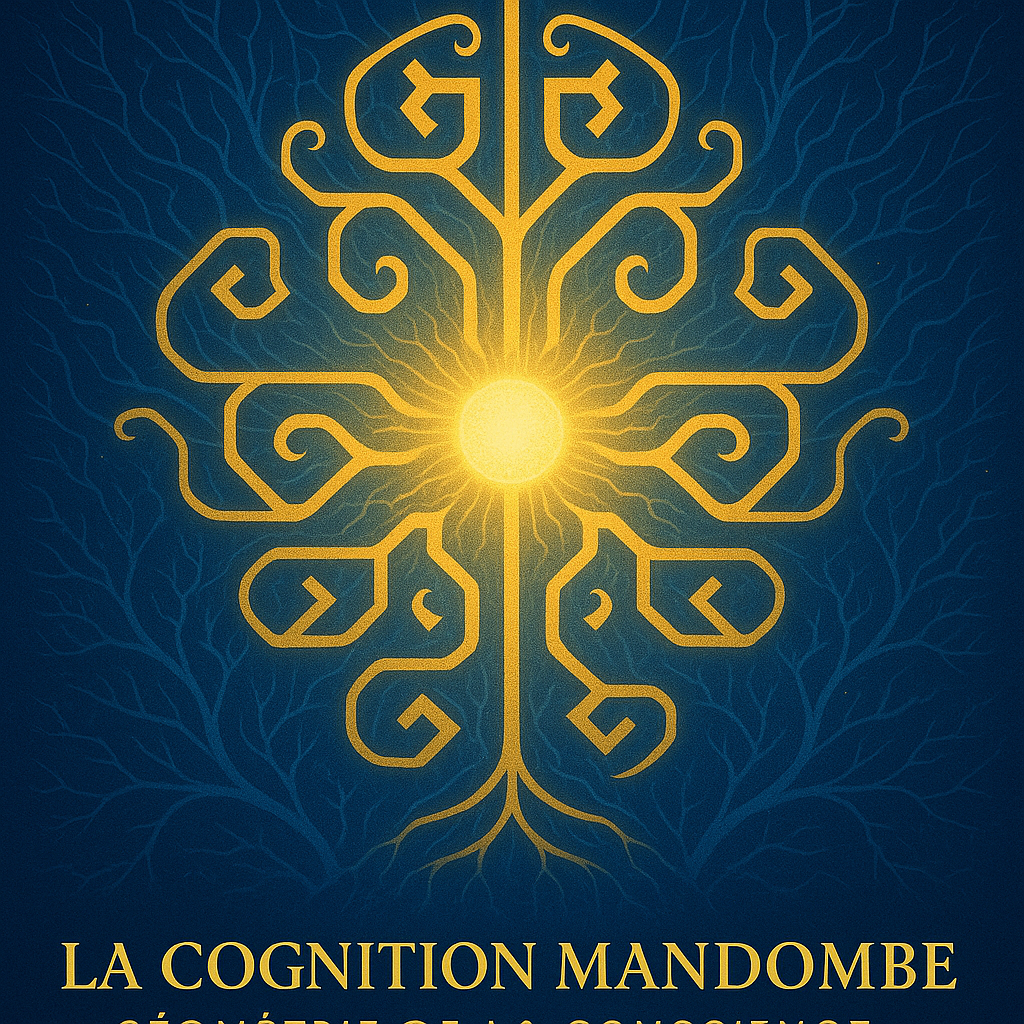
Mandombe letters are constructed from a small set of base shapes (mvuala) that can be rotated and combined according to strict rules. Branches attached to these shapes must appear in precise positions for a letter to be considered complete. Learning to read and write Mandombe therefore involves:
discriminating rotated versions of complex shapes;
tracking the presence, absence and orientation of branches;
maintaining multi-segment patterns while producing strokes in sequence.
Each writing exercise requires adolescents to hold in mind and manipulate rotated, branched forms. Over months and years, this practice plausibly trains mental rotation and visuospatial working memory in a way that Latin script, with its relatively simpler letter rotations and less systematic branching, does not.
2.3 Relational ethics and moral reasoning
Mandombe teaching, as formalised in the MEN-D curriculum, is explicitly linked to African philosophies of relational personhood. The notion of completeness is not only geometric; it extends to social life. A mvuala lacking a branch is “not yet itself”; restoration of missing parts mirrors restorative justice and communal repair. In class discussions and proverbs, teachers connect these ideas to everyday conflicts, cooperation and responsibility.
Moral reasoning research distinguishes stages from self-interest and fear of punishment, through pure rule-obedience, toward relational and principled reasoning that considers the perspectives of others and the restoration of social balance. The Mandombe ethical frame offers a vocabulary and a set of images for talking about harm and repair: relationships as shapes that can be damaged, completed or rebalanced. It is plausible that adolescents immersed in this symbolic world will come to frame moral problems in more relational, restorative terms.
2.4 Cognitive imbalance after colonial schooling
The DSM-H framework and related MEN-D work argue that colonial schooling in Africa produced a characteristic cognitive imbalance: verbal and rote skills over-developed relative to visuospatial, creative and ethical-relational capacities. Imported tests then confirmed this imbalance as “deficit,” ignoring that the symbolic environment itself was skewed. Restoring cognitive balance would require not only new content but new symbolic infrastructures that exercise neglected capacities.
Mandombe is one such infrastructure. If its geometry and ethics meaningfully affect adolescents’ mental rotation, working memory and moral reasoning, this would support the claim that symbolic choices can be levers for cognitive health, not mere cultural accessories.
---
3. Method
3.1 Design overview
The study used a longitudinal cohort design with two matched groups:
Mandombe group (MG): adolescents enrolled in recognised Mandombe programmes in addition to standard schooling;
Control group (CG): adolescents in comparable schools and grades without Mandombe exposure.
Both groups were assessed at baseline (T0) and after approximately 18 months (T1) on locally constructed cognitive and moral tasks.
3.2 Setting and participants
Participants were recruited from secondary schools and Mandombe centres in Kinshasa. Inclusion criteria:
age between 12 and 16 years at T0;
continuous enrolment in the same school type over the study period;
for MG, regular Mandombe instruction (minimum three hours per week) planned for at least 18 months;
for CG, no participation in Mandombe classes during the study.
After consent procedures, 82 adolescents were enrolled: 42 in MG and 40 in CG. Attrition over 18 months (family moves, school changes) left 38 MG and 36 CG participants with complete data.
At T0, groups were comparable in age distribution, sex ratio and teacher-reported academic level. A brief non-verbal reasoning test confirmed similar baseline fluid abilities across groups.
3.3 Mandombe instruction
MG participants attended Mandombe classes delivered by certified instructors under the official MEN-D programme. Instruction covered:
reading and writing of Mandombe letters and syllables;
geometric analysis of letters (rotations, mirrorings, branch positions);
basic Mandombe-based mathematics and pattern generation;
occasional group discussions linking script structure to cooperation, responsibility and justice, in line with the official curriculum.
Attendance logs indicated an average of 3–4 hours of Mandombe contact per week. CG participants received regular schooling in French and/or Lingala with no Mandombe exposure and no substitute enrichment programme of comparable intensity.
3.4 Construction of tasks
To avoid importing test formats unmoored from local practice, we followed a three-step approach.
1. Extraction from MEN-D materials.
We examined existing Mandombe classroom exercises used with adolescents: mental rotation of letters and patterns, copying and transforming branch structures, group memory games based on position of signs on grids, and moral proverbs discussed in class.
2. Creation of neutral equivalents.
For each exercise type, we constructed versions that preserved formal properties (number of segments, angles, rotations, grid size, text length) but replaced Mandombe forms with neutral abstract shapes or generic figures. For example, a rotation task using mvuala-based patterns became a task with invented geometric figures matched for complexity.
3. Pilot calibration.
We piloted both Mandombe-styled and neutral tasks on a separate group of adolescents not involved in Mandombe programmes. Item difficulty was adjusted until performance distributions overlapped: the goal was equivalence of challenge, not advantage for either style.
Only after this calibration did we select the final tasks for longitudinal use. During the actual study, MG received the Mandombe-styled versions and CG the neutral versions, with identical instructions.
3.5 Measures
3.5.1 Mental rotation
Participants completed a paper-and-pencil task comprising 20 items. Each item displayed a target shape and four alternatives, one of which was the target rotated by 45–315 degrees. The other three were distractors with altered branch positions or segment lengths.
MG shapes were stylised mvuala-based patterns.
CG shapes were neutral patterns matched for line count and symmetry.
Participants indicated the matching shape. Accuracy and completion time were recorded.
3.5.2 Working memory
Two forms of working memory were assessed:
Visuospatial span: A 4×4 grid was briefly shown with a sequence of positions highlighted (2–7 steps). Participants then had to reproduce the sequence by pointing to blank grids.
Verbal span: Digit span forward and backward with sequences of 2–8 digits read aloud.
Span length was defined as the longest sequence length with at least two correct trials.
3.5.3 Non-verbal reasoning
A short pattern-completion task with 12 matrix items assessed general fluid reasoning. Items were neutral, non-Mandombe designs showing sequences of shapes with one missing element. Participants chose the missing element from four options.
3.5.4 Moral reasoning
Four vignettes depicted realistic dilemmas in Congolese school and neighbourhood life:
1. A student tempted to cheat in an exam to help a cousin.
2. A group excluding a weaker classmate from a game.
3. A conflict over stolen phone credit between friends.
4. A senior student using their position to intimidate younger ones.
Each vignette was presented orally and in simple written form. After each, participants answered two open questions:
“What should the main person do?”
“Why is that the best thing to do?”
Responses were audio-recorded and later transcribed.
A coding scheme adapted from stage theories of moral development distinguished three main orientations:
M1 – Self-interest / punishment-focused: decisions based mainly on avoiding trouble, getting rewards, or fear of sanctions.
M2 – Rule-based / authority-focused: emphasis on obeying rules, pleasing authorities or following instructions, without deeper relational analysis.
M3 – Relational / restorative: focus on repairing relationships, restoring fairness or balance, considering perspectives of all parties and long-term consequences for the community.
Each participant received a dominant orientation level based on their overall pattern across vignettes.
3.6 Procedure
At T0, both groups completed the cognitive tasks and moral vignettes over two sessions of approximately 45 minutes each, scheduled within normal school hours. Testing order was counterbalanced. Assessors were trained graduate students familiar with local languages; they were informed that some participants studied Mandombe but not which group was expected to show particular changes.
At T1, 18 months later, the same tasks were re-administered with parallel item sets of comparable difficulty. Whenever possible, the same assessor tested the same participant to minimise interpersonal variance.
3.7 Data analysis
For each outcome, we computed change scores (T1–T0) and used linear models controlling for baseline values, age and sex to compare MG and CG. Effect sizes were expressed as standardised mean differences. For moral reasoning, we examined transitions between M1, M2 and M3 over time and compared the proportion of participants reaching or consolidating M3 in each group.
Given the sample size, the analysis focused on pattern and magnitude rather than fine p-value thresholds. The central question was whether differences clustered in domains that Mandombe structurally trains (rotation, visuospatial memory, relational ethics) while leaving more generic capacities unchanged.
Ethical approval was obtained from the relevant institutional committee, and participation was voluntary.
---
4. Results
4.1 Baseline comparability
At T0, MG and CG did not differ meaningfully in mental rotation accuracy, visuospatial span, verbal span or non-verbal reasoning. The distribution of moral reasoning orientations was also similar: most adolescents in both groups were classified as M1 or M2, with only a small minority showing predominantly relational/restorative reasoning (M3). Teacher-reported grades and attendance did not differ significantly between groups.
4.2 Mental rotation
Over 18 months, both groups improved on the rotation task, but gains were larger in MG. Descriptively, MG accuracy improved by an average of roughly one-third more than CG, and MG completion time decreased more. In regression models controlling for baseline scores, age and sex, group membership remained a significant predictor of improvement.
Importantly, this effect was observed regardless of whether items used shapes similar to those directly practised in Mandombe classes or more abstract patterns, suggesting a degree of transfer beyond rote familiarity with specific forms.
4.3 Working memory
Visuospatial span increased in both groups, reflecting general maturation and schooling, but MG showed greater gains. After adjusting for baseline span and demographics, MG participants remembered on average one additional grid position compared to CG at T1.
Verbal digit span also increased slightly in both groups, but differences between MG and CG were small and not systematic. This divergence—stronger between-group differences for visuospatial span than for verbal span—is consistent with the idea that Mandombe practice particularly exercises spatial working memory rather than boosting global memory capacity.
4.4 Non-verbal reasoning
Scores on the pattern-completion task improved modestly and similarly in both groups. There was no clear evidence that Mandombe instruction influenced general fluid reasoning over and above standard schooling. This stability helps to rule out explanations in terms of a broad, unspecific advantage: the domains that changed most were those closest to the structure of the script.
4.5 Moral reasoning
At T0, the majority of participants in both groups framed decisions predominantly in M1 or M2 terms: avoiding trouble, respecting rules or satisfying teachers and parents. Over 18 months, changes diverged.
In MG, many adolescents began to articulate M3-type reasoning, emphasising repair and relational balance. For example, in response to the exclusion vignette, MG responses at T1 included:
“If they leave him outside, the group is incomplete; they must bring him back so that everyone is equal again.”
“The best is to repair what was broken between them, not just punish one person.”
In the cheating vignette, some MG participants linked ethical choices to completeness:
“If he cheats, he will pass but he will be incomplete inside; it is better to stay honest and help the cousin study after.”
In CG, moral reasoning also evolved, with some shift from M1 to M2: more emphasis on rules and fairness. However, fewer participants moved into stable M3 patterns, and relational or restorative language was less frequent. Responses often justified decisions by reference to school rules or parental expectations, without exploring how relationships could be repaired.
Quantitatively, a substantially higher proportion of MG participants moved from M1/M2 to predominantly M3 orientation than CG participants. While these figures should be interpreted cautiously given sample size, the direction and specificity of the pattern mirror the cognitive findings: changes concentrate in domains that Mandombe teaching explicitly engages.
4.6 Sensitivity analyses
We explored potential confounds. Adding attendance and self-reported study time as covariates did not eliminate the group differences in rotation, visuospatial span or moral transitions. Excluding the small number of highest-achieving students in each group reduced effect sizes but preserved the same pattern. There was no evidence that MG participants simply received more total hours of generic instruction; their additional time was specifically in Mandombe classes.
---
5. Discussion
5.1 Summary of findings
Over an 18-month period, adolescents receiving regular Mandombe instruction, in addition to standard schooling, showed larger gains than matched peers in mental rotation, visuospatial working memory and relational/restorative moral reasoning. Improvements in verbal span and general non-verbal reasoning were comparable across groups.
This pattern does not justify broad claims about superior intelligence. It does support a more focused conclusion: sustained engagement with a rotational, branch-based, relational script appears to shape the very domains it structurally targets, while leaving others broadly aligned with standard developmental trajectories.
5.2 Symbolic education as mechanism
The simplest reading is that Mandombe functions as a long-term, low-intensity training regime for specific cognitive operations. Every week, adolescents in MG manipulate rotated shapes, track branches, and reason about completeness and relational repair in concrete symbolic form. Over eighteen months, this accumulates into measurable differences in rotation ability, spatial span and moral framing.
Generic explanations such as “better teachers,” “more motivated students” or “more schooling hours” are not fully satisfying. If the effect were primarily about general quality or quantity of schooling, we would expect broader advantages across all domains, including verbal span and non-verbal reasoning. Instead, gains cluster tightly in areas where Mandombe’s design is most distinctive.
5.3 Avoiding asymmetric test bias
The study also illustrates a methodological point. It would be obviously unfair to design a test battery based on Mandombe letters, administer it to European adolescents who have never seen the script, and then interpret low scores as evidence of European cognitive deficit. Yet the reverse has often been standard practice: culturally dense Western tasks are exported, poor performance by African children is pathologised, and the misalignment between tool and environment is ignored.
By starting from Mandombe classroom tasks, building neutral equivalents, piloting them locally, and only then comparing Mandombe and non-Mandombe cohorts, this study attempts to flip that script. Here, the symbolic system is African, and the test is adapted outward rather than imported inward. The goal is not to declare a new universal norm, but to demonstrate that when indigenous symbolic environments are taken as the reference point, different cognitive strengths and trajectories become visible and understandable.
5.4 Cognitive balance and DSM-H
Within the DSM-H framework, colonial schooling is understood as having over-developed certain narrow forms of verbal and hierarchical reasoning at the expense of spatial, relational and ethical faculties. The current findings, while limited, are consistent with efforts to restore balance. Mental rotation and visuospatial working memory are not luxuries; they underpin navigation, technical skill and flexible problem-solving. Relational moral reasoning supports social cohesion and resistance to dehumanising structures. If symbolic education through Mandombe helps adolescents reclaim these dimensions without sacrificing general reasoning, it becomes part of a broader therapeutic strategy for post-colonial minds.
5.5 Limitations
Several limitations must be underscored.
1. Non-random assignment to programmes. Adolescents self-select or are selected into Mandombe classes. Although baseline equivalence reduces concerns, unmeasured differences in family support or aspirations may contribute to outcomes.
2. Sample size and single city. The study involves under 80 adolescents from Kinshasa. Generalisation to rural areas or other countries must be cautious.
3. Measurement constraints. While tasks were locally derived and piloted, they still compress complex capacities into brief test sessions. Mental rotation is broader than one paper test, and moral reasoning extends beyond written or spoken vignettes.
4. Unmeasured aspects of pedagogy. Mandombe classes may differ from standard classes in more than content: class climate, teacher–student relationships, or group identity may all play roles.
These limitations mean that symbolic education should be seen as one strand in a bundle of factors, not the sole cause of observed changes.
5.6 Future research
Future work can deepen and challenge these findings in several ways:
Randomised or quasi-experimental designs, for example by randomising access to new Mandombe centres when demand exceeds available places.
Neurocognitive measures, such as eye-tracking or neuroimaging, to see whether different brain networks are preferentially engaged or strengthened.
Behavioural outcomes, linking cognitive and moral shifts to concrete behaviour in school, community initiatives, or conflict resolution.
Cross-cultural studies, carefully designed, that explore how Western adolescents perform on carefully explained Mandombe-based tasks and how African adolescents fare on equally foreign symbolic systems, not to rank but to understand plasticity and specificity.
Such research would refine our understanding of how deeply symbolic environments shape cognition and ethics across development.
---
6. Conclusion
This study adds a modest but important piece to the emerging picture of Mandombe’s educational and cognitive impact. Over 18 months, adolescents engaged in regular Mandombe instruction exhibited domain-specific advances in mental rotation, visuospatial working memory and relational moral reasoning relative to matched peers in standard schools. These differences align closely with the geometric and ethical structures of the script, suggesting that symbolic design matters for cognitive evolution.
The findings do not license grand claims about superior intelligence or simple policy fixes. They do, however, undermine the notion that scripts and symbolic systems are neutral backdrops. In contexts marked by the legacy of colonial schooling, choosing to educate through a script that systematically trains rotation, branching and relational completeness is not a cosmetic gesture. It is a concrete step toward rebuilding a more balanced cognitive profile, one in which African adolescents can develop spatial, mnemonic and ethical capacities on their own symbolic terms.
---
References:
Nsiangani K. (2020) Comparative Cognitive Study in African Children; Nsiangani K. (2021) MEN-D Curriculum