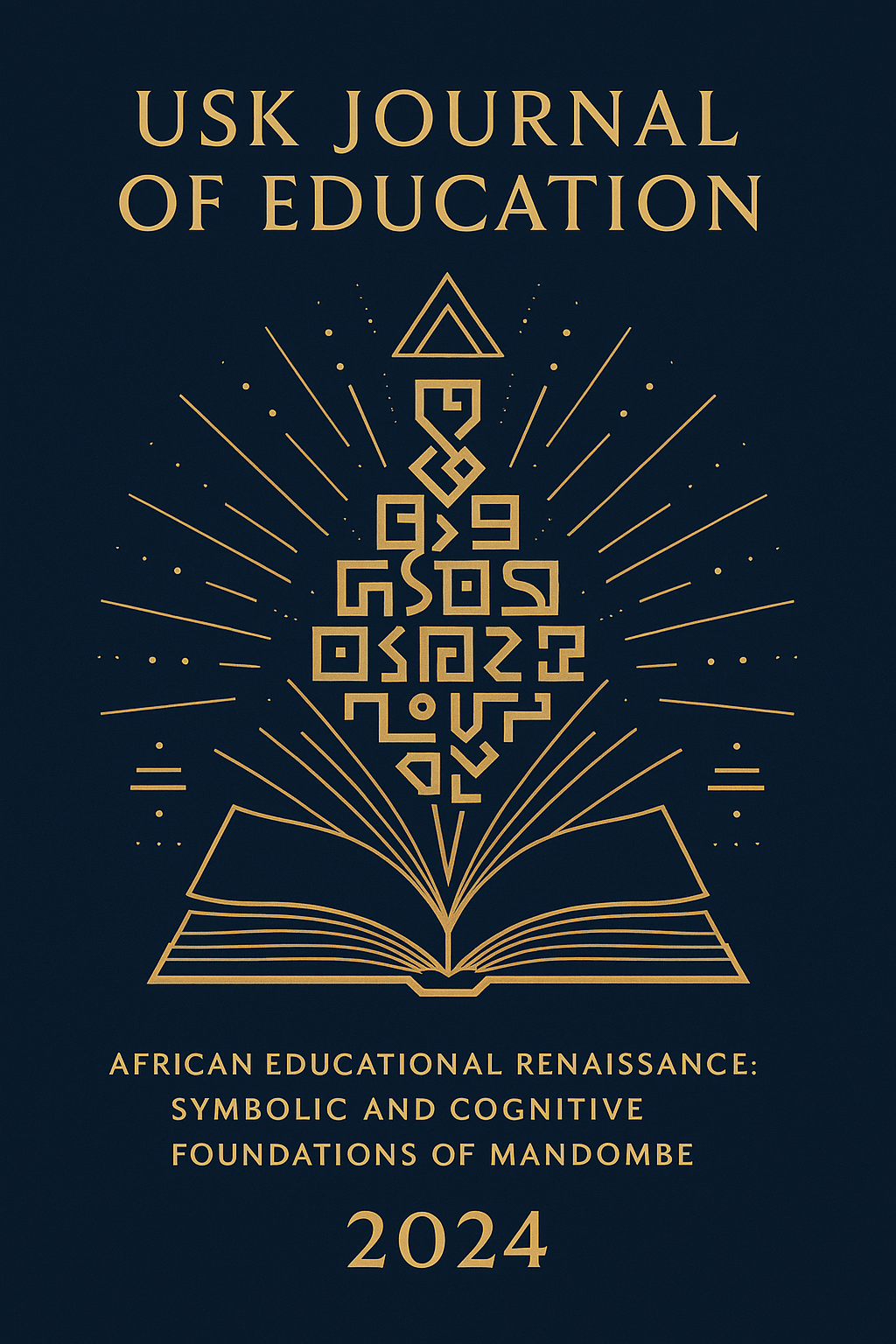
Symbolic Cognition and the Geometry of Knowledge: Foundations of Mandombe Logic
Keywords:
Mandombe, cognition, epistemology, symbolic logicAbstract
Title
From Singini to Cognitive Grammar: Formalising Mandombe as a Geometric Logic of Reasoning
Keywords
Mandombe, cognition, epistemology, symbolic logic, African mathematics
---
Abstract
This article formalises the internal geometry of Mandombe as a cognitive grammar of reasoning rather than as a simple writing system. Building on From Singini to Spacetime (2014) and the Corpus Fondateur du Département Mandombe (2021), I show that the script’s primitives and transformations form a finite, well behaved algebra whose symmetry and recursion can support African models of knowledge, causality and complementarity.
I define four core primitives – singini (origin point), mvuala (base cell), kisimba (branch) and yikamu (volumetric unit) – and a small set of operations: rotation, reflection, branching, concatenation and recursion. I demonstrate how this grammar generates families of forms that can encode phonology, prosody and morphology for Bantu languages, and at the same time express basic logical relations such as identity, opposition, inclusion and implication. Short constructions illustrate how mvuala–kisimba configurations can model syllables, number systems, causal chains and moral evaluations within a single geometric vocabulary.
The claims are deliberately precise. This is a structural and conceptual paper. It does not present new behavioural data and cannot by itself prove cognitive or clinical effects. Its contribution is to specify a formal grammar that is finite, inspectable and testable. On that basis I derive concrete predictions for cognitive science and neuroscience, including expected differences in orientation sensitivity, mental rotation, continuous stroke planning and shape–emotion mapping in children educated through Mandombe. I also outline how this grammar underpins higher level frameworks such as Mandombe Geometric Algebra (MGA), Rotational Symmetry Epistemology (RSE), Epistemic Symbolic Networks (ESN) and diagnostic projects like the DSM-H and the Dark Tetrad of Empire.
The article is written first for African contexts: for Nsanda teachers, for students in Congo and across the continent, and for researchers who wish to build mathematics, cognitive science and epistemology from within African symbolic traditions. Readers outside these contexts are welcome interlocutors, but they are not the reference point or arbiter for the system’s legitimacy. The aim is to establish the grammatical spine upon which empirical work, mathematical development and decolonial epistemology can be built and evaluated.
1. Introduction
Mandombe is usually described briefly as a “modern African script” created to write Kikongo, Lingala and related languages. This neutral phrase hides something essential. A script that simply maps sounds to arbitrary glyphs does not need strict three dimensional orientation, volumetric projection, continuous stroke rules or curvature encoded affect. Mandombe requires all of these from the first lessons.
In a Nsanda class the child does not only learn that a sign corresponds to /ba/ or /ki/. The child learns that:
every form grows from a visible singini origin;
a mvuala is ambiguous until a kisimba branch defines its orientation;
small rotations and reflections change sound, tone and grammatical role;
each zita must be written in one continuous path from singini to endpoint;
length, curvature and angularity of branches change the “mood” and “voice” of the glyph.
For three decades these constraints have been used didactically without a compact formal description of the underlying grammar. In From Singini to Spacetime I argued that Mandombe behaves more like a miniature geometric physics than like a linear alphabet. In the Corpus Fondateur du Département Mandombe I framed this intuition institutionally inside the Département Mandombe. What was still missing was an explicit, finite grammar that others could inspect, test and extend.
My aim here is not to add one more narrative about “African writing systems”. It is to formalise Mandombe as a cognitive grammar of reasoning, in a way that:
is faithful to actual classroom practice in Nsanda centres;
can be written as an algebra of primitives and operations;
is rich enough to support phonology, logic and epistemology;
produces testable predictions for cognitive and neural development.
The structure follows a simple progression. In Section 2 I define the primitives and operations that constitute the grammar. In Section 3 I map this grammar to symbolic logic and give a concrete phonological example. In Section 4 I relate the resulting formalism to Kongo and wider African epistemic structures. In Section 5 I derive cognitive and neural predictions and indicate how they may be falsified. Section 6 clarifies scope and limits. Section 7 situates this work relative to external misreadings of Mandombe, to Western classificatory habits and to my broader corpus (MGA, RSE, ESN, DSM-H, Dark Tetrad of Empire). Section 8 concludes.
Throughout I keep the decolonial stance simple: an African-born formal system is articulated in its own language and structure, and will be judged by its internal coherence and its usefulness in African institutions, not by its resemblance to imported models.
2. Primitives and operations of the Mandombe grammar
2.1 Primitives
I adopt four primitives that appear consistently in teaching, correction and advanced constructions. They are not “letters” in the Latin sense. They are roles in a generative system.
1. Singini (S)
Singini is the origin mark, usually drawn as a dot. In practice it is the point from which every stroke begins. In the grammar, S is the distinguished reference point from which coordinates, rotations and paths are defined. Cognitively it embodies the fact that every act of writing and reasoning starts from a chosen standpoint and not from nowhere.
2. Mvuala (M)
A mvuala is a base cell. It is a simple geometric form defined by its potential orientations, not by a single fixed pose. A mvuala and its 180° rotation are visually identical until a kisimba attaches. Teachers and children know that “a mvuala alone is unclear”. Formally, I treat mvuala as typed units that can host branches and rotations.
3. Kisimba (K)
A kisimba is a branch that attaches to a mvuala and resolves its ambiguity. By attaching on a given side, with a given length and curvature, it defines the mvuala’s orientation and identity. In classroom language, “the kisimba defines the mvuala”. In the grammar, K encodes relational determination: a unit becomes fully specified through the way it is linked.
4. Yikamu (Y)
A yikamu is a volumetric unit, a cluster of mvuala and kisimba that must be imagined in three dimensions and then projected into two. Children explicitly learn to “turn” parts of a yikamu in their mind and to choose the correct projection. In the grammar, Y denotes structured units whose meaning depends on internal transformation.
These primitives are sufficient to describe the core behaviour of Mandombe at the level of basic glyphs, syllables and simple diagrammatic constructions.
2.2 Operations
On this set of primitives I define a small family of operations. Each operation has a concrete writing instruction and an associated cognitive demand.
Rotation Rθ
Rθ turns a mvuala–kisimba configuration by angle θ around its singini. In practice, 90°, 180° and 270° rotations are the main ones used. R modifies the sound, tone or grammatical role of the unit. A 90° rotation may mark a different consonant series, consonant–vowel pattern or tonal contour.
Reflection F
F mirrors a configuration across a vertical or horizontal axis. Some reflections are licensed and carry meaning, others are explicitly forbidden in teaching because they create illegible or confusing forms. Reflections often encode complementary or opposing values.
Branching B
B adds or removes a kisimba on a given side of the mvuala, with specified length and curvature. In practice these parameters carry both segmental and prosodic information: a certain curvature marks softness, a sharp angle marks tension, a longer branch slows the “tempo” of the glyph.
Concatenation ⊕
⊕ links units along a path. Concatenation allows syllables to build words, numerals to build expressions and conceptual steps to build reasoning chains. The visual continuity of the path carries structural information.
Recursion ρ
ρ embeds one unit inside another at a different scale or layer. A smaller yikamu can be nested inside a larger configuration to represent a condition inside a process, a sub-story inside a story, or a local coordinate system inside a wider frame.
A generic configuration such as
> ρ( Rθ( B(M, K₁) ) ⊕ Rφ( B(M', K₂) ) )
corresponds to an actual writeable form with a clear sequence of strokes, and each transformation corresponds to a cognitive operation the learner must perform.
2.3 Symmetry and constraint
Mandombe’s grammar does not allow arbitrary transformations. Its symmetry structure is finite and constrained.
For a given mvuala type, allowed orientations under rotation form a small cyclic group C₄. Reflections are restricted; some F operations are disallowed by design to avoid degenerate or ambiguous characters. Branching is subject to length and curvature constraints that are taught and corrected.
The lawful glyph set G is therefore a proper subset of all possible configurations of mvuala and kisimba under R, F and B. Children quickly internalise a clear distinction between allowed and forbidden transformations. That distinction is a training ground for logical notions such as “valid” versus “invalid” moves in a reasoning sequence. A child who can say “this reflection is not allowed in our script” already grasps that not every syntactically imaginable move is legitimate.
3. From geometric grammar to symbolic logic
3.1 Logical relations in geometric dress
With primitives and operations defined, I can ask whether this grammar is expressive enough to capture basic logical relations. I do not impose an external logic on the system. I look for correspondences that arise naturally in practice.
Several such correspondences are straightforward.
Identity
Re-encountering a mvuala–kisimba configuration under the same orientation and branching pattern expresses identity. In teaching, this is the basis for letter and word recognition. In the grammar it corresponds to equality of geometric state.
Opposition
Licensed reflections or 180° rotations can express structural opposition. A Kongo diagram that represents life and death as mirrored positions finds a natural home here. The same applies to moral oppositions when teachers illustrate “balanced” versus “unbalanced” characters.
Inclusion
Recursively nesting a yikamu inside a larger configuration expresses inclusion. A condition placed inside a larger process, an individual inside a clan, or a sub-space inside a cosmogram can all be drawn as ρ(Y₁ inside Y₂).
Implication
A continuous path from configuration A to configuration B, where B cannot be drawn without first passing through A, expresses a directional dependency. When children are asked to trace from one state to another they implicitly learn that some endpoints presuppose certain beginnings.
These relations are not metaphors layered after the fact. They are visible in pedagogical practice whenever Mandombe is used to explain “if… then…”, “before… after…”, “inside… outside…”.
3.2 A phonological micro-example
To anchor abstraction in a concrete case, consider a simplified representation of a Kikongo CV syllable.
Let:
M₀ be a base mvuala type assigned to the consonant class /b/;
R90(M₀) correspond to /d/;
R180(M₀) correspond to /g/;
B(M₀, Kᵥ) correspond to the addition of a vowel /a/ when Kᵥ branches on the “south” side;
B(M₀, Kᵢ) correspond to a vowel /i/ when branching on the “east” side.
Then, schematically:
R0( B(M₀, Kᵥ) ) might encode [ba];
R90( B(M₀, Kᵥ) ) encode [da];
R0( B(M₀, Kᵢ) ) encode [bi];
R90( B(M₀, Kᵢ) ) encode [di].
In practice the mapping is richer, including tone and morphosyntactic features. The point here is that rotation R and branching B can serve simultaneously as carriers of consonantal and vocalic information. The same operations can later be reused to mark derivational relations, aspect, mood or polarity.
This means that the operations introduced to the child as “turn it like this” and “attach the branch here” already carry the structure needed to express phonological systems and to stack morphological layers. There is no need to import an external symbolic language to formalise these distinctions.
3.3 Logical minimalism
From the preceding examples one can define a minimal mapping between Mandombe grammar and a core logical vocabulary:
Propositional states as mvuala–kisimba configurations;
Negation or opposition as specific reflections or rotations;
Conjunction as concatenation along a path;
Inclusion as recursion;
Implication as a constrained path from one configuration to another.
This does not reduce Mandombe to Western propositional logic. It shows that the same geometric grammar can express such relations directly. African epistemic concepts can therefore be formalised natively, without forcing them into foreign notation.
4. From logic to African epistemology
4.1 Genealogy and continuity
The grammar described here did not arise in a vacuum. Mandombe stands in continuity with older Kongo and Central African symbolic traditions that use quadrants, circles, crossings and axes to encode relations such as life–death, visible–invisible, ancestor–descendant and above–below.
The Kongo cosmogram is a clear example. A horizontal line separates visible and invisible worlds, a vertical line marks the axis of power, and quadrants encode stages in the life cycle. Rotations on this diagram already carry epistemic content: moving from one quadrant to another is moving between states of being.
When Mandombe uses rotation and crossing to change value, it speaks the same language in a more granular way. The mvuala–kisimba–yikamu system is not an imported algebra imposed on African thought. It is a refinement and extension of a grammar that already existed in cosmograms, ritual diagrams and carved patterns, brought into the domain of explicit literacy.
4.2 Anti-essentialist clarification
When I say that Mandombe supports African epistemology I do not mean that “Africans think this way by nature” or that there is a single African mind. I mean that there are historical epistemic traditions in Africa that have used rotation, reflection, complementarity and cyclicity as core tools, and that Mandombe provides a formalism well aligned with those tools. Any person, of any origin, can learn and use the grammar. The system is African by birth and genealogy, not by genetic destiny.
4.3 Epistemic constructions
With this in mind one can sketch how the grammar can encode some central epistemic structures.
Complementarity
Complementary states, such as life and death, male and female, visible and invisible, can be represented as licensed reflections or rotations around a common singini, with shared mvuala type and different kisimba. Their relation is not a simple opposition but a structured pairing.
Cyclicity
Cycles can be drawn as concatenations of oriented mvuala that return to the same singini after a series of rotations. Life–death–rebirth patterns or seasonal cycles can thus be formalised without changing notation.
Relational personhood
A bare mvuala appears underdetermined. Attaching kisimba that link it to others generates a stable configuration. This mirrors relational conceptions of the person, where identity emerges through kinship, obligation and participation.
Nested knowledge
Recursion allows a proverb to be embedded inside a story, a ritual inside a cosmogram, a local diagnosis inside a larger historical frame. Epistemic nesting becomes a geometric nesting instead of a footnote in a foreign script.
These examples are not exhaustive, but they show the reach of the grammar. It can host syllables, numbers, causal diagrams and cosmological maps inside one coherent system.
5. Cognitive and neural predictions
A grammar, by itself, does not guarantee any cognitive effect. It must be used, rehearsed and embodied. The Nsanda context provides this rehearsal. Children learn to read and write Mandombe in parallel with Latin script. If the grammar is cognitively active, it should leave traces in perception, attention and neural organisation.
I summarise here a set of predictions that are precise enough to be tested and falsified.
5.1 Behavioural predictions
1. Orientation sensitivity
Children trained in Mandombe should show higher sensitivity to small orientation changes in non-linguistic shapes than peers educated only in Latin script. This should appear in discrimination tasks and in reduced tolerance for rotated distractors.
2. 2D–3D mapping
Because yikamu require mental rotation and projection, Mandombe learners should perform better on simple 2D–3D matching tasks involving cubes or block towers, even when no glyphs are present.
3. Continuous stroke planning
The rule that a zita must be written in one continuous path should manifest as a tendency to plan longer, smoother strokes in drawing tasks, with fewer unnecessary lifts and segmentations.
4. Shape–emotion mapping
Due to the systematic use of curvature and angle to encode affect, Mandombe learners should more readily associate line qualities with emotional labels and should remember emotion-tagged shapes better than neutral ones.
5. Transfer limits
These advantages should be domain specific. One should not expect broad gains in verbal span or generic IQ scores solely from Mandombe exposure.
5.2 Expected neural signatures
At the neural level, if the grammar shapes cognition, one may expect:
sharper orientation tuned responses in early visual cortex for abstract shapes;
more efficient recruitment of parietal regions during mental rotation and 2D–3D projection tasks;
distinctive patterns of premotor and cerebellar activity during continuous stroke drawing;
stronger coupling between visual shape areas and regions involved in prosody and emotion when processing line-quality–emotion pairings.
These are hypotheses, not facts. They can be investigated with EEG and fMRI in Nsanda cohorts and Latin-only cohorts. If such differences fail to appear, or appear equally in contexts unrelated to Mandombe, then the specific training role attributed to the grammar would be weakened. If they appear consistently and generalise to non-script stimuli, then the hypothesis that Mandombe functions as a cognitive discipline would be strengthened.
The primary aim of this framework is to equip African institutions with a native formal foundation for such work. External validation is useful, but it is not the horizon of the project.
6. Scope, limits and falsification
This is a structural paper. Its limits are clear.
First, it presents no new behavioural or neural dataset. Its purpose is to formalise a grammar and to articulate predictions. Validation must come from separate empirical work.
Second, it does not claim that Mandombe is intrinsically superior to other scripts, nor that it alone can decolonise education. Scripts function inside institutions. Institutions can use them to liberate or to control.
Third, it does not treat African epistemology as a museum object. The grammar presented here is a living proposal. Communities will adapt it, argue over it, extend it and in some cases reject it. The system will stand or fall by its coherence and usefulness in African classrooms and research centres.
Falsification is straightforward. If future studies find that Mandombe learners do not differ from Latin-only peers on orientation, 2D–3D tasks, stroke planning or shape–emotion mapping, then the idea that the grammar trains these operations would be undermined. If, on the contrary, such differences appear robustly and connect to identifiable neural signatures, then the hypothesis that Mandombe functions as a cognitive discipline will be strengthened.
7. Discussion
7.1 Relation to external descriptions and Westernalism
Some external descriptions have presented Mandombe primarily as an ethnographic curiosity or as a marginal literacy campaign. In such accounts it is filed alongside “vernacular scripts” as a colourful symptom of local religiosity rather than as a formal system of thought. This is not surprising. Without an explicit account of the internal geometry, the script can only appear as folklore on a Western classificatory shelf.
I do not engage specific authors at length here, because they operate within a grid that this paper leaves behind. It is enough to state the structural fact: when a research tradition refuses to see the grammar of a non-European system, and insists on treating it as excess religion or exotic ornament, it is not merely mistaken. It behaves like the very Dark Tetrad of Empire that the DSM-H describes, reproducing narcissistic centrality, instrumentalisation and epistemic sadism at the level of classification.
The purpose of this article is not to correct individuals. It is to provide the formal description that was missing, so that future discussions of Mandombe, whether sympathetic or hostile, must address its actual algebra rather than their fantasies about African writing.
7.2 Position relative to MGA, RSE and ESN
The grammar presented here is the base layer for several other frameworks already in development.
Mandombe Geometric Algebra (MGA) extends the mvuala–kisimba–yikamu system into a full algebra capable of expressing rotations, reflections and higher dimensional transformations for physics and computation.
Rotational Symmetry Epistemology (RSE) uses the same symmetry group to formalise balance, inversion and structural justice in knowledge production and governance.
Epistemic Symbolic Networks (ESN) implement the grammar in computational models and AI architectures, treating mvuala–kisimba configurations as nodes in dynamic state spaces rather than as static glyphs.
These layers lie beyond the scope of this article. They depend on the grammatical layer defined here and derive their legitimacy from its internal coherence. The task accomplished in this text is to fix that layer clearly so that higher algebraic, epistemological and computational work can be evaluated on a shared basis.
7.3 Link to DSM-H and the Dark Tetrad of Empire
My diagnostic projects, including the DSM-H and the Dark Tetrad of Empire, require a way to describe how pathological structures encode themselves in symbols, diagrams and institutional routines. Until now that representational level was handled informally. By treating Mandombe as a cognitive grammar I gain a native formal language in which structural pathologies of empire can be drawn, checked and contested without borrowing foreign algebra. The clinical and political applications lie outside the present article, but they rest on the grammatical spine established here.
7.4 Implications for research and education
For cognitive science and neuroscience, the implications are methodological. Instead of asking “does literacy change the brain” in an abstract way, one can compare specific grammars of literacy as different cognitive ecologies. Mandombe, Latin, Arabic and other scripts can be analysed in terms of their primitives and operations, and empirical work can measure how these influence attention, memory and neural organisation.
For African education, the implication is that Mandombe can serve not only as one more script but as a unifying geometric language for literacy, numeracy, basic physics and ethical reasoning. Exercises in mvuala space can simultaneously train reading, counting, causal modelling and moral reflection, because they reuse the same operations.
For African epistemology, the implication is more direct. We are no longer forced to write African concepts in borrowed symbols and then translate them back into our own images. We can write them directly in a script whose grammar is congruent with Kongo and wider African logics of complementarity and cyclicity, and which has now been formalised in a way that others can scrutinise.
8. Conclusion
Mandombe is not a decorative variation on European scripts. It is a coherent geometric proposal. In this article I have treated that proposal as a candidate cognitive grammar of reasoning. By defining its primitives and operations, mapping them to simple symbolic logic and situating them within African epistemic traditions, I have tried to show that Mandombe can host not only sounds and words, but chains of reasoning, cycles of life and structures of justice.
The claims remain disciplined. I do not ask anyone to believe that Mandombe magically produces superior minds. I ask that the script be recognised as a formal system with a transparent grammar. On that basis, empirical researchers, mathematicians, educators and philosophers can test, extend or refute the hypotheses presented here.
This framework is addressed first to African classrooms and research centres. It will stand or fall by its usefulness there, not by the comfort it offers to external observers. If the work succeeds, it will be because it gives my students, colleagues and critics a clear, shared grammar from which to begin. From singini onward, the path is now visible.
References
Nsiangani, K. (2014). From Singini to Spacetime.
Nsiangani, K. (2021). *Corpus Fondateur du Département Mandombe